 Sarah Mills
Egg eating happens fast. One day your girls are laying beautifully, and then you reach into the nesting box and find a sticky mess of yolk and shell fragments, and suddenly you’re wondering if you’ve done something terribly wrong. You might be wondering whether this is a one-bird problem or a flock problem, whether it’s fixable, or whether you’re about to lose every egg you ever collect again. I’ve been there. It’s genuinely unsettling the first time you see it.
Here’s what I tell people right away: egg eating is almost always a symptom, not a character flaw in your chickens. That framing matters, because if you go into problem-solving mode thinking “I’ve got a bad egg eater,” you’ll probably handle it differently than if you ask “what need isn’t being met here?” Both approaches get used. One of them works more consistently.
Why Chickens Start Eating Eggs in the First Place
The two most common triggers are nutritional deficiency and accidental discovery. Let’s start with nutrition, because it’s the one most people overlook.
Eggshells are made almost entirely of calcium carbonate. If a hen’s diet is calcium-deficient, her body is essentially running a deficit every single day she lays. At some point, instinct kicks in: here is a calcium-rich object right in front of me. She pecks. She finds yolk and protein underneath. Now you have a problem with two reinforcing factors instead of one.
This is more common than hatchery websites let on. Hens in peak lay (roughly 25-35 weeks of age, depending on breed) are producing an egg roughly every 24-26 hours. That’s an enormous metabolic demand. Layer feed formulated to 3.5-4% calcium will cover most hens most of the time, but if you’re also feeding a lot of scratch grains, kitchen scraps, or treats, you’re diluting that calcium percentage without realizing it. I made this mistake myself in my second year when I got enthusiastic about fermented feed and supplemental scratch and didn’t think carefully about what I was actually diluting. My Barred Rocks started laying thin-shelled eggs, and within two weeks, one of them had discovered that thin shells crack easily.
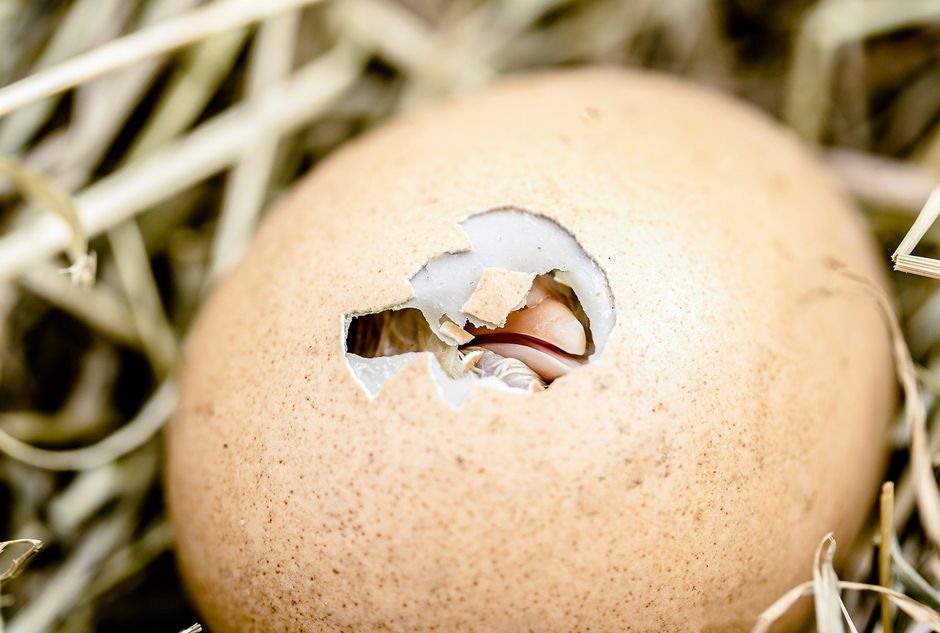
The accidental discovery path is different. A hen steps on an egg. The egg breaks. She investigates (chickens investigate everything with their beak), she gets a mouthful of rich yolk and protein, and the association is formed. This can happen completely independently of any nutritional issue. And once one bird learns it, others watch and learn. Chickens are annoyingly good at social learning when it involves food.
There’s a third trigger that doesn’t get mentioned enough: boredom and overcrowding. A hen with not enough space and not enough to do will investigate things more aggressively. The general rule of 4 square feet per bird inside the coop is genuinely a minimum, not a comfortable baseline.
The Nutritional Piece, Broken Down
You might be wondering what the actual numbers look like and whether your feed is covering it. Here’s a breakdown of what matters:
| Nutrient | Minimum for Layers | Signs of Deficiency | Fix |
|---|---|---|---|
| Calcium | 3.5-4.5% of diet | Thin shells, soft eggs, egg eating | Offer oyster shell free-choice |
| Protein | 16-18% of diet | Feather picking, egg eating, poor lay rate | Switch to higher-protein layer feed |
| Sodium | 0.15-0.2% of diet | Egg eating, excessive pecking behavior | Check feed label; rarely an issue with quality feed |
| Phosphorus | 0.35-0.45% of diet | Thin shells (works with calcium) | Usually balanced in commercial layer feed |
The single most practical fix for calcium deficiency costs almost nothing: put out a separate container of oyster shell and let hens take what they need. They’re surprisingly good at self-regulating calcium intake. I use a simple hanging feeder mounted in the corner of the coop, something like this gravity-style feeder on Amazon (our site may earn a commission on purchases). Hens that need more calcium will eat more. Hens that don’t, won’t. I’ve never seen a hen overdo it.
Protein is the other one worth watching. During molt especially, protein demand spikes because feathers are roughly 85% protein. Hens who are molting and still trying to lay are running a significant nutritional deficit. Temporarily bumping protein to 18-20% with a flock raiser feed or adding mealworms can help more than you’d expect. A 50-pound bag of Purina Flock Raiser currently runs around $22-28 at most feed stores as of July 2026, which is a reasonable swap for a season.
What Happens When It’s Not About Nutrition
Here’s something I got wrong for years. I assumed every case of egg eating was nutritional. I was wrong about that.
Sometimes it’s entirely behavioral. The hen figured out eggs are delicious, full stop. She doesn’t have thin shells. She doesn’t have protein deficiency. She just learned a behavior that gets reinforced every time she does it. That bird is harder to deal with, honestly.
The fix for behavioral egg eating is more about management than diet:
Collect eggs frequently. Multiple times a day if possible. Twice a day is the baseline; three times is better if you have the habit. The longer eggs sit, the more likely they are to get broken accidentally, and the more opportunity the egg eater has.
Darken the nesting boxes. Hens are less likely to peck at eggs they can’t see well. Curtains over the box openings genuinely help. I’ve used strips of burlap stapled over the top edge of the box and it made a noticeable difference within a week.
Use roll-away nesting boxes. This is the closest thing to a foolproof solution for persistent behavioral egg eaters. The box is slightly angled so that when a hen lays, the egg rolls gently away from her reach into a covered compartment. She can’t get to it. The Brinsea or KERBL-style rollaway boxes cost $30-80 depending on size and configuration, which sounds like a lot until you do the math on eggs you’re losing every week.
Fake eggs and mustard. This is old advice and it sort of works. You put a ceramic or wooden egg (or a golf ball) in the nest, and when the hen pecks it and gets nothing, it can dull the habit. Some people blow out a real egg and fill it with mustard, which hens dislike. I’ve tried the golf ball method with genuinely mixed results. Two out of three times it helped. Once, the bird pecked the golf ball so aggressively I was concerned about her beak. Your results may vary.
Worked Examples from Real Flocks
Scenario 1: Small backyard flock of 6 hens, heavy on scratch and kitchen treats, shells getting noticeably thinner. One Buff Orpington discovered she could crack and eat eggs. Action taken: added free-choice oyster shell, cut scratch to no more than 10% of daily intake, collected eggs twice daily. Result: shell quality improved within 10 days, egg eating stopped completely within 3 weeks. No birds culled.
Scenario 2: A reader named Karen from western Tennessee emailed me after she’d tried the mustard egg trick twice with no success. Her flock was 8 hens in a 6x8 coop (that’s 6 square feet per bird, reasonable). Nutrition looked fine. One specific Australorp was the culprit. Action: Karen installed a single rollaway nesting box for $48, separated the Australorp from the other boxes by rearranging the coop layout. Result: problem solved within 4 days. The Australorp laid just fine, she just never got access to the egg after.
Scenario 3: Winter flock, 12 hens, confined to coop for 3 weeks during bad weather. No obvious nutritional issue, no thin shells, but egg eating started after day 10 of confinement. This was boredom. Action: added a hanging head of cabbage (cheap, entertaining, keeps them busy), increased the protein content of their feed temporarily, started collecting eggs three times daily. Result: behavior resolved within 2 weeks once the weather broke and they had outdoor access again.
The Hardest Question: Do You Cull the Egg Eater?
I’m not going to pretend this isn’t sometimes the answer. If you have identified one specific persistent egg eater and nothing is working, and she’s teaching the behavior to others, you have to make a call. An egg eater who has fully habituated to the behavior and who is actively recruiting others is going to cost you more than she produces. That’s a hard truth, but it’s the reality of keeping a flock for any kind of production.
That said: I’d exhaust the rollaway box, the diet adjustment, the collection schedule, and the nesting box darkening before I got there. Most cases don’t require culling. Most cases are nutritional or management-related and fix themselves once you address the root cause.
What I don’t recommend is the old advice of trimming the upper beak. It’s stressful for the bird, not always effective, and there are better options.
Sources
- University of Florida IFAS Extension: “Layer Production and Egg Quality” publication on calcium requirements and deficiency symptoms in laying hens
- Merck Veterinary Manual: Chapter on nutritional deficiencies in poultry, covering calcium, protein, and behavioral secondary symptoms
- Penn State Extension: “Controlling Egg Eating in Poultry” bulletin with management recommendations for backyard flock keepers
- Gail Damerow, The Chicken Health Handbook (Storey Publishing, 2nd ed.): practical reference covering behavioral and nutritional causes of egg eating, widely considered the most useful single-volume reference for backyard flock keepers
Photo: Andreas Ebner via Pexels