 Sarah Mills
You walk out to the coop on a Tuesday morning, toss in the scratch, and one of your hens just… stands there. Doesn’t run for the feed. Doesn’t jockey for position like usual. She’s puffed up, tail down, and when you pick her up she feels lighter than she should. Most new chicken keepers see that and think “she’s probably just tired.” I’ll be honest: that hen might be 24 to 48 hours from dying. Chickens are prey animals. They hide illness aggressively, hardwired by evolution to avoid looking weak. By the time a chicken looks sick to an untrained eye, she’s often been sick for days.
How Chickens Hide Illness (And Why That Works Against You)
Here’s what catches people off guard most: a hen fighting an infection, dealing with an impacted crop, or in the early stages of egg yolk peritonitis will often continue to eat, move around, and even lay eggs for a surprisingly long time. The flock dynamic makes it worse. Healthy birds sometimes physically chase or peck sick ones, so a sick hen has extra reason to act normal around her flockmates.
What surprised me was how fast the window closes once visible symptoms appear. I’ve had Barred Rocks and Rhode Island Reds, both notoriously tough breeds, go from “slightly off” to dead in under 36 hours. Silkies and Polish? Even faster.
So build a baseline. Know what your individual birds look like when they’re healthy. Know their weight, their posture, the color of their comb, how fast they move toward food. A kitchen scale and a quick monthly weigh-in for each bird sounds obsessive, but it’s caught early illness in my flock twice. A hen who drops 10% of her body weight without a molt or a broody spell is worth watching closely.
The Core Symptoms to Know, and What They Actually Mean
| Symptom | Possible Causes | Urgency |
|---|---|---|
| Puffed feathers, tail down | Infection, heat loss response | Monitor closely |
| Pale or discolored comb | Anemia, dehydration, internal illness | High |
| Purple or blue-tinged comb | Respiratory emergency | Immediate |
| Labored breathing, rattling sounds | Mycoplasma, Infectious Bronchitis, Newcastle Disease, Aspergillosis, gapeworm | High |
| Thick yellow discharge from eyes/nostrils | Bacterial or viral respiratory disease | High |
| Full, hard crop (morning) | Impacted crop | High |
| Large, squishy, sour-smelling crop | Sour crop (yeast overgrowth) | High |
| Yellow-green droppings with lethargy | Liver disease, Marek’s Disease | High |
| Bloody droppings (birds under 12 weeks) | Coccidiosis | Immediate |
| Leg paralysis, twisted neck | Marek’s Disease, Newcastle Disease, nutritional deficiency | High |
| Straining without egg production | Egg-bound | Immediate |
Not all symptoms point to the same problem. Misreading them can cost you a bird. Here’s what you’re likely to see and what it actually means:
Puffed feathers with tail down: This is the classic sick chicken posture. The bird is cold or trying to conserve heat, which is what a sick bird does when her body is fighting something. It’s nonspecific, but always a red flag.
Lethargy or standing apart from the flock: Healthy chickens are social. A hen who stands alone or doesn’t compete for resources is telling you something’s wrong.
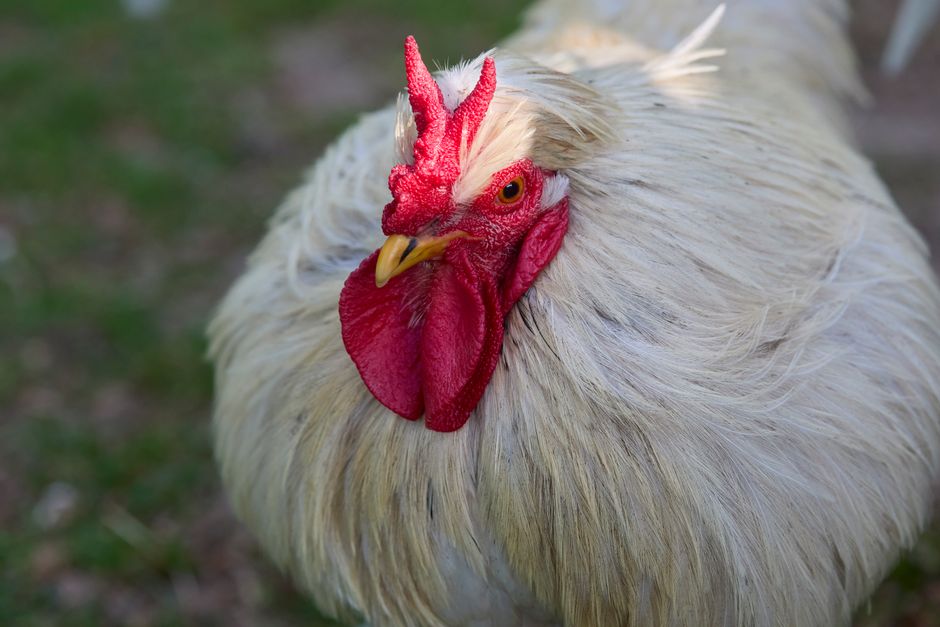
Pale or discolored comb: A healthy laying hen has a bright red, plump comb. Pale pink or shrunken means anemia (often from lice or mites), dehydration, or serious internal illness. Purple or blue-tinged is a respiratory emergency. Separate that bird now.
Labored breathing, open-mouth breathing, rattling sounds: These point to respiratory infection, and the list is long: Mycoplasma gallisepticum, Infectious Bronchitis, Newcastle Disease, Aspergillosis (from moldy bedding), or gapeworm. Don’t assume it’s minor.
Discharge from eyes or nostrils: Watery eyes alone can be dust irritation. Thick, foamy, or yellow discharge alongside respiratory sounds is almost certainly bacterial or viral respiratory disease.
Crop issues: A full, hard crop in the morning (before eating) is impacted crop. A large, squishy, sour-smelling crop is sour crop, a yeast overgrowth. Both need treatment. Neither fixes itself.
Diarrhea or abnormal droppings: Cecal droppings (dark brown, smelly, almost liquid) are normal. Watery, yellow-green, or bloody droppings are not. Yellow-green droppings with lethargy often indicate liver disease or Marek’s Disease. Bloody droppings in birds under 12 weeks should trigger immediate coccidiosis treatment.
Limping, twisted neck, or neurological symptoms: Marek’s Disease causes leg paralysis and is devastating in backyard flocks. Twisted neck (torticollis) can mean Newcastle Disease, vitamin E or selenium deficiency, or a head injury. A vet visit is the right call here.
Egg laying changes: A hen who abruptly stops laying, lays soft-shelled eggs, or strains without producing anything may be egg-bound, a life-threatening condition.
Step-by-Step: What to Do When You Find a Sick Hen
20 Signs That Your Chicken Is Sick. You Need To Know Them ALL! · Country Living Experience: A Homesteading Journey on YouTube
Acting fast matters. Here’s what I do every time I spot a bird who doesn’t look right.
Step 1: Separate her immediately. Move her to a clean dog crate or separate enclosure, sometimes called a “hospital coop.” This protects her from pecking, reduces stress, and prevents potential disease spread. A cardboard box with ventilation holes works short-term.
Step 2: Weigh her. Get a kitchen scale and a small container she can sit in. Record the weight and track whether she’s deteriorating.
Step 3: Do a full physical exam. Check the crop before she eats in the morning, feel her abdomen for bloating or fluid, inspect her vent for blockage or prolapse, part her feathers and look for lice or mites near the vent and neck, check her comb color.
Step 4: Watch droppings for 24 hours. Fresh droppings tell you a lot. Keep a photo record.
Step 5: Provide supportive care while you figure out the cause. Warm environment (a heat lamp set to one side so she can self-regulate), fresh water with electrolytes, and a probiotic supplement. Rooster Booster Poultry Cell is a liquid vitamin and mineral supplement I keep on hand specifically for sick birds. Note: This site may earn a commission on qualifying Amazon purchases.
Step 6: Call a vet if you see respiratory symptoms, neurological signs, bloody droppings, or if she’s not eating after 24 hours. I know some people resist vet visits for chickens, but a fecal float test and basic bloodwork can tell you in 20 minutes what you’d spend a week guessing. A poultry-savvy vet is worth finding before you need one.
Step 7: Decide on biosecurity. If you suspect contagious disease, treat the flock as potentially exposed. Hold off on new birds, clean waterers and feeders with diluted bleach, and monitor everyone closely for 10 to 14 days.
Respiratory Illness vs. Internal Laying vs. Parasites: A Quick Comparison
| Symptom Cluster | Likely Cause | Urgency | Treatment Direction |
|---|---|---|---|
| Rattling breath, nasal discharge, lethargy | Respiratory disease (Mycoplasma, IB, Newcastle) | High | Vet, possible antibiotics |
| Bloated abdomen, penguin stance, decreased laying | Egg yolk peritonitis / internal laying | High | Vet, often poor prognosis |
| Pale comb, weight loss, feather-pulling | Lice or mites | Medium | Permethrin dust or spray, treat coop |
| Bloody droppings, lethargy (young birds) | Coccidiosis | High | Corid (amprolium) immediately |
| Leg paralysis in young birds | Marek’s Disease | High/Terminal | Supportive care, culling consideration |
| Twisted neck, disorientation | Vitamin E deficiency or Newcastle | Medium-High | Vitamin E/selenium supplement, vet if no improvement |
| Squishy, sour-smelling crop | Sour crop (yeast overgrowth) | Medium | Antifungal, dietary adjustment |
| Hard crop in morning | Impacted crop | Medium-High | Massage, olive oil, possible vet intervention |
The Diseases Most Backyard Keepers Don’t Prepare For
Sources
I spent the first three years keeping chickens completely unprepared for Marek’s Disease. Nobody talks about it on the glossy hatchery pages. Marek’s is a herpesvirus that spreads through dander and dust, present in virtually every flock environment, and causes leg paralysis, vision loss, and tumors. Vaccination at hatch is standard prevention, and most hatcheries do vaccinate, but it’s not 100% protective. It suppresses symptoms but doesn’t prevent infection. If you’re buying from a farm store or local breeder, ask specifically about vaccination status.
Egg yolk peritonitis is another blindsider. A hen’s ovulation goes sideways and yolk material ends up in the abdominal cavity instead of the oviduct. The abdomen fills with fluid and infected material. She looks like a penguin, stands upright with a swollen belly, often has a greenish pallor to her comb. The prognosis is poor. I’ve lost two birds to it, both production-oriented breeds (a Golden Comet and an ISA Brown) bred to lay heavily. High-production breeds really are more prone to reproductive disorders. It’s a real trade-off worth understanding before you stock your flock.
Infectious Coryza is a bacterial disease that smells. Literally. There’s a foul, sweet odor, swollen faces, and nasal discharge. It spreads rapidly. The Chicken Health Handbook by Gail Damerow is the single best reference I’ve found for diagnosing and treating these diseases at home, and I’d recommend every keeper own a copy. This site may earn a commission on qualifying purchases.
The hardest part of keeping chickens isn’t the feed math or coop construction. It’s learning to read an animal biologically programmed not to show you it’s struggling. The more time you spend with your birds when they’re healthy, the faster you’ll catch when something shifts. That gap, that window between “something’s off” and “she’s in crisis,” is small. It closes faster than you think. Trust your gut when a bird doesn’t look right. You’ll be wrong sometimes. But the times you’re right, it’ll matter.
Photo: cute 嘟 via Pexels